

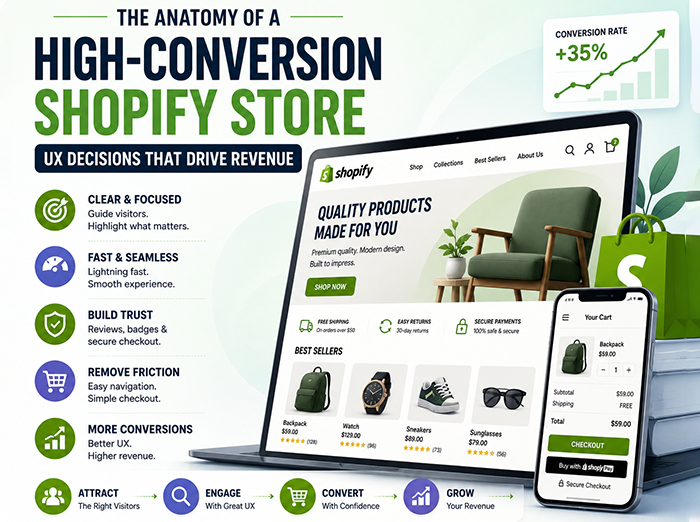







UX Decisions That Drive Revenue
Launching a Shopify store is easier than ever. Turning that store into a revenue-generating machine is an entirely different challenge.
Many online businesses invest heavily in advertising, influencer marketing, and SEO to drive traffic, only to discover that visitors leave without making a purchase. The issue often isn’t the product or the marketing—it’s the user experience.
Today’s customers expect websites that are fast, intuitive, and frictionless. Every second of loading time, every unnecessary click, and every confusing interaction increases the likelihood that potential customers abandon their purchase.
A high-converting Shopify store is not built by chance. It’s designed with careful attention to customer psychology, conversion optimization, and technical performance.
In this guide, we’ll break down the key UX decisions that directly influence conversion rates and explain how thoughtful Shopify development can significantly increase online revenue.
Why User Experience Matters More Than Ever
Research consistently shows that users form an opinion about a website within just a few seconds.
If visitors struggle to navigate your store, cannot find products quickly, or experience delays during checkout, they rarely give the business a second chance.
Modern ecommerce success depends on reducing friction throughout the buying journey.
The goal is simple:
Make purchasing feel effortless.
Every interaction should guide customers naturally toward completing their purchase.
Understanding the Shopify Conversion Funnel
Before optimizing anything, it’s important to understand where customers typically drop off.
The typical conversion journey looks like this:
Visitor → Product Discovery → Product Page → Cart → Checkout → Payment → Order Confirmation
Every stage introduces opportunities for hesitation.
Common problems include:
- Slow-loading pages
- Confusing navigation
- Poor product organization
- Hidden shipping costs
- Complicated checkout forms
- Lack of trust signals
- Mobile usability issues
Improving conversion means eliminating these obstacles one by one.
First Impressions Begin with Homepage Clarity
Many Shopify stores try to impress visitors by adding everything to the homepage.
Large sliders.
Multiple promotions.
Numerous banners.
Several popups.
The result is visual overload.
Instead, successful stores immediately answer three questions:
- What do you sell?
- Why should customers trust you?
- What should visitors do next?
A clear headline, compelling imagery, concise messaging, and a strong call-to-action consistently outperform cluttered homepages.
Good design creates confidence.
Great design creates action.
Navigation Should Feel Invisible
Customers should never have to think about where to click.
Navigation should simply make sense.
High-performing Shopify stores organize products logically using intuitive categories and search functionality.
Some best practices include:
Keep Menus Simple
Avoid overwhelming users with dozens of menu options.
Group products into logical collections.
Use descriptive category names instead of internal terminology.
Powerful Search Matters
Many ecommerce visitors know exactly what they’re looking for.
Autocomplete search, predictive suggestions, and typo correction dramatically improve product discovery.
The faster customers find products, the more likely they are to purchase.
Product Pages That Sell
Your product page is your digital salesperson.
Every element should build confidence and remove doubt.
Successful Shopify product pages typically include:
Professional Photography
Customers cannot touch your products.
Images become their substitute.
Include:
- Multiple angles
- Lifestyle photography
- Zoom functionality
- Videos
- 360-degree views where appropriate
Better visuals consistently increase conversions.
Clear Product Descriptions
Avoid generic manufacturer descriptions.
Instead, explain:
- Benefits
- Real-life use cases
- Materials
- Dimensions
- Care instructions
- Frequently asked questions
Focus on helping customers make informed decisions.
Social Proof
Reviews remain one of the strongest conversion drivers.
Display:
- Verified customer reviews
- Ratings
- User-generated photos
- Testimonials
Social proof reduces uncertainty.
The Psychology of Micro-Interactions
Micro-interactions are subtle animations and interface responses that reassure users.
Although small, they significantly improve user confidence.
Examples include:
- Button hover effects
- Cart update animations
- Loading indicators
- Progress bars
- Success confirmations
- Wishlist animations
These interactions communicate that the website is responding correctly.
Without feedback, users become uncertain.
Uncertainty kills conversions.
Mobile Optimization Is No Longer Optional
More than half of ecommerce traffic now comes from mobile devices.
Yet many Shopify stores are still designed primarily for desktop users.
Mobile optimization extends beyond responsive layouts.
It requires designing specifically for touch interactions.
Best practices include:
- Large tap targets
- Sticky Add-to-Cart buttons
- Thumb-friendly navigation
- Readable typography
- Compressed images
- Simplified forms
- Fast page loads
Every unnecessary tap increases abandonment rates.
Speed Is a Conversion Factor
Website speed directly impacts revenue.
Even a one-second delay can reduce conversion rates.
Customers expect instant experiences.
Improving Shopify performance includes:
Optimizing Images
Large image files remain one of the biggest causes of slow ecommerce websites.
Modern formats like WebP dramatically reduce loading times.
Minimizing Third-Party Apps
Many merchants install dozens of Shopify apps.
Each app introduces additional JavaScript.
More JavaScript means slower performance.
Regular audits help remove unnecessary apps.
Lazy Loading
Images below the fold should load only when needed.
This improves perceived speed.
Code Optimization
Custom themes should eliminate unnecessary scripts and optimize CSS delivery.
Professional development often produces significantly faster websites than heavily modified pre-built themes.
Reducing Checkout Friction
Customers have already decided to buy.
Don’t lose them at checkout.
Checkout optimization is one of the highest ROI improvements any ecommerce business can make.
Offer Guest Checkout
Forced account creation remains one of the largest causes of cart abandonment.
Allow customers to complete purchases first.
Accounts can always be created later.
Minimize Form Fields
Every additional field creates friction.
Only request information necessary to complete the purchase.
Shorter forms convert better.
Display Shipping Costs Early
Unexpected shipping fees are among the leading reasons customers abandon carts.
Whenever possible:
- Show estimated shipping early.
- Be transparent.
- Avoid surprises.
Multiple Payment Options
Customers prefer flexibility.
Offer trusted payment methods including:
- Credit cards
- Digital wallets
- Shop Pay
- Apple Pay
- Google Pay
- PayPal (where available)
Convenience increases completed purchases.
Building Trust Throughout the Store
People buy from businesses they trust.
Trust signals should appear naturally across the customer journey.
Examples include:
- SSL security badges
- Secure payment icons
- Return policies
- Shipping information
- Customer reviews
- Money-back guarantees
- Contact information
- Live chat availability
Trust reduces purchase anxiety.
Personalization Drives Higher Revenue
Modern customers expect personalized shopping experiences.
Shopify stores can leverage:
- Recently viewed products
- Personalized recommendations
- Frequently bought together suggestions
- Dynamic product bundles
- Location-aware messaging
- Loyalty rewards
Relevant personalization increases average order value while improving customer satisfaction.
Leveraging Headless Commerce for Speed and Flexibility
As businesses grow, many begin to outgrow traditional storefront limitations.
This is where headless commerce becomes valuable.
A headless Shopify architecture separates the frontend presentation layer from the backend ecommerce engine.
The result is significantly greater flexibility.
Benefits include:
Faster Performance
Developers can build lightweight frontends using modern frameworks such as React or Next.js, resulting in dramatically faster page loads.
Better User Experience
Headless architecture enables richer interactions, custom animations, and highly optimized customer journeys that are difficult to achieve with traditional themes.
Greater Scalability
Businesses can support multiple storefronts, mobile apps, kiosks, or regional websites from a single Shopify backend.
Future-Proof Development
As technology evolves, businesses can update the frontend without rebuilding the ecommerce infrastructure.
While headless commerce isn’t necessary for every business, high-growth brands often benefit from the additional flexibility and performance.
Measuring What Actually Matters
A beautiful website means little if it doesn’t convert.
Successful ecommerce businesses continuously monitor performance metrics such as:
- Conversion Rate
- Cart Abandonment Rate
- Checkout Completion Rate
- Average Order Value
- Customer Lifetime Value
- Bounce Rate
- Mobile Conversion Rate
- Page Load Time
Data should guide optimization decisions—not assumptions.
Continuous Testing Beats One-Time Redesigns
Many businesses redesign their website once every few years.
High-performing ecommerce brands continuously improve.
Regular A/B testing helps optimize:
- Headlines
- Product images
- Call-to-action buttons
- Product page layouts
- Checkout flow
- Pricing displays
- Promotional banners
Small improvements compound over time into substantial revenue growth.
Common Shopify UX Mistakes That Hurt Sales
Even well-designed stores can lose customers due to avoidable usability issues. Some of the most common mistakes include:
- Slow-loading pages caused by oversized images or excessive apps
- Overly complex navigation that makes products difficult to find
- Weak or inconsistent calls-to-action
- Hidden shipping costs that surprise customers during checkout
- Poor mobile usability
- Low-quality product imagery
- Generic product descriptions
- Missing trust signals
- Long checkout forms
- Failure to test and optimize regularly
Addressing these issues can significantly improve both customer satisfaction and conversion rates.
How SelahTech Builds Shopify Stores That Convert
At SelahTech, we believe ecommerce success comes from combining exceptional design with robust engineering.
Our Shopify development approach focuses on measurable business outcomes—not just aesthetics.
We help businesses:
- Design conversion-focused user experiences
- Build custom Shopify themes tailored to their brand
- Optimize mobile performance
- Improve Core Web Vitals and page speed
- Streamline checkout experiences
- Integrate third-party systems and payment gateways
- Develop scalable headless Shopify solutions
- Continuously optimize stores using analytics and user behavior insights
Whether you’re launching a new online store or improving an existing one, our goal is simple: create an ecommerce experience that turns more visitors into loyal customers.
Final Thoughts
A high-converting Shopify store is the result of hundreds of thoughtful decisions working together. Fast performance, intuitive navigation, compelling product pages, frictionless checkout, and mobile-first design all contribute to higher conversion rates and stronger customer loyalty.
Rather than relying on trends or guesswork, successful ecommerce brands invest in continuous optimization backed by data and user behavior. Every improvement—no matter how small—can have a measurable impact on revenue.
If your Shopify store is attracting visitors but not converting them into customers, it’s time to look beyond marketing and evaluate the user experience. The right UX and development strategy can transform your store from simply functional to consistently profitable.
Frequently Asked Questions
1. What makes a Shopify store high-converting?
A high-converting Shopify store combines fast loading speeds, intuitive navigation, persuasive product pages, mobile optimization, trust signals, and a frictionless checkout process to maximize completed purchases.
2. Why is mobile optimization important for Shopify stores?
With most ecommerce traffic coming from mobile devices, a mobile-first design ensures customers can browse and purchase easily, reducing bounce rates and increasing conversions.
3. What is headless Shopify?
Headless Shopify separates the frontend from the Shopify backend, allowing developers to build highly customized, faster, and more scalable shopping experiences using modern frameworks like React and Next.js.
4. How can I reduce cart abandonment?
Reduce checkout friction by offering guest checkout, minimizing form fields, displaying shipping costs upfront, supporting multiple payment options, and ensuring a fast, secure checkout experience.
5. How often should I optimize my Shopify store?
Optimization should be an ongoing process. Regularly monitor analytics, conduct A/B tests, and refine your site’s UX based on user behavior to continuously improve conversion rates.